Doctoral study
Doctoral education positions at BEAT/COGSYSG groups are advertised continuously on this page.
We thank all applicants for their interest in the PhD position and for the time they invested in preparing their applications.
Due to the overwhelming number of applications received, we will contact only those candidates who have been selected for the next stage of the process. Unfortunately, it is not possible for us to respond individually to all applicants.
We appreciate your understanding.
PhD Position: Computational Modeling of Structural Brain Connectivity from Diffusion MRI - CLOSED
To be a doctoral student means to devote oneself to a research project under supervision of experienced researchers and following an individual study plan. For a doctoral degree, the equivalent of four years of full-time doctoral education is required.
Basic Info
Supervisor: Ing. Milan Němý, Ph.D.
Specialist / co-supervision: Prof. Dr. Ben Jeurissen
Department: Cognitive Systems and Neurosciences, CIIRC, CTU in Prague
Field of study: Cybernetics and Robotics
Department website: https://www.ciirc.cvut.cz/cs/teams-labs/cogsys/
Candidate Profile
We are looking for a motivated candidate with interest in one or more of the following areas:
machine learning and pattern recognition
medical image analysis
diffusion MRI and tractography
computational neuroscience
Experience with neuroimaging, MRI processing, optimization, or deep learning is an advantage, but strong quantitative and programming skills are equally welcome.
The research Group
The Nemy Lab is a newly established research group comprising experienced researchers at various career stages, united by a shared focus on neurodegenerative diseases, neuroimaging, neuroscience, and biomedical engineering. Our primary area of specialization is the human cholinergic system and its critical role in neurodegenerative diseases, including Alzheimer’s disease, Lewy Body disease, and vascular dementia. The lab’s work centers on developing and applying advanced imaging and image-processing techniques to model, segment, and quantify the cholinergic system, pushing the boundaries of our understanding and measurement of this key neural network.
Embedded within the Cognitive Systems and Neurosciences group at the Czech Institute of Informatics, Robotics, and Cybernetics (CIIRC CTU), we benefit from close collaborative links with both local (Motol Hospital, Military University Hospital Prague) and international research institutions (Karolinska Institute, DZNE, University Fernando Pessoa). This network supports our lab’s mission to remain at the forefront of neuroimaging innovation and application in neurodegenerative research.

The doctoral student project and the duties of the doctoral student
We are offering a PhD position focused on the development of advanced computational methods for modeling structural brain connectivity from diffusion MRI. The project lies at the intersection of neuroimaging, machine learning, and computational neuroscience, and aims to improve the way long-range white-matter pathways and their cortical projections are quantified in vivo.
Understanding structural brain connectivity is essential for studying cognition, healthy aging, and neurological disease. However, reliable estimation of white-matter pathways from diffusion MRI remains challenging. Clinical diffusion data are often limited in quality and resolution, tractography is sensitive to methodological choices, and many standard analyses reduce complex pathways to a few global summary measures. This PhD project addresses these limitations by developing robust, scalable, and biologically interpretable computational tools for connectivity analysis.
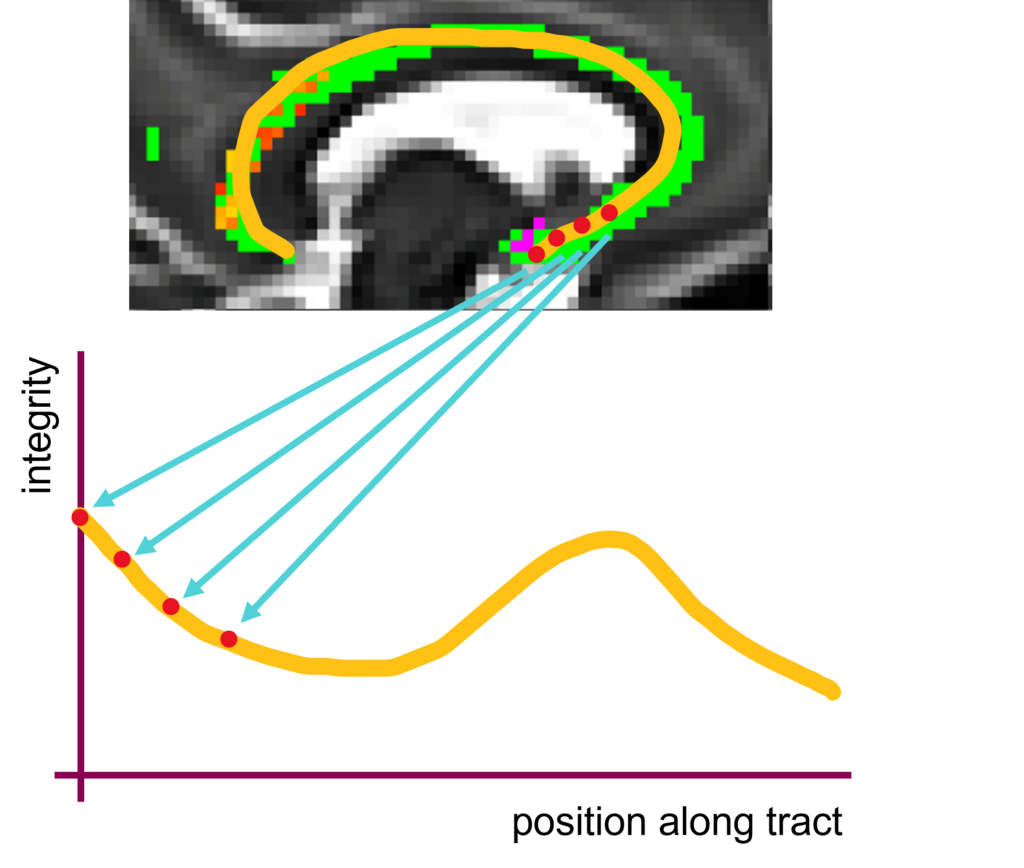
The research will focus on building a modern diffusion-MRI workflow that combines advanced signal modeling, tractography, and machine learning. Key directions include constrained spherical deconvolution for resolving complex fiber configurations, optimization-based and global tractography strategies to improve anatomical plausibility, and learning along-tract and branch-specific profiles that capture spatial variation in microstructure. The project will also investigate pathway-to-cortex projection patterns using endpoint and termination density proxies, enabling the creation of rich connectivity “fingerprints” for data-driven analyses.
By integrating advanced diffusion modeling with biologically meaningful tractography optimization and machine-learning-based feature extraction, the project aims to deliver practical tools for structural connectivity analysis that are robust to real-world acquisition constraints and sensitive to subtle spatial effects along pathways and at cortical targets. The resulting framework is expected to improve sensitivity to longitudinal and between-group differences, support reproducible analyses across datasets, and provide interpretable features for downstream modeling of brain structure and disease.
As a doctoral student, you will play a leading role in study design, data analysis, and the writing, presentation, and publication of results. This project includes collaboration with both local and international laboratories, where you will have the chance to learn and adopt new techniques. You will also work closely with, and learn from, pioneering scientists in the field, providing you with an inspiring and supportive environment for your research journey.
What do we offer?
We provide a creative and inspiring environment, rich in expertise and driven by curiosity. CIIRC CVUT is a key player in neuroimaging and computational neuroscience, offering state-of-the-art equipment, extensive computational power through our clusters, and modern offices located close to the center of Prague. As a doctoral student, you’ll receive an individual research project under the guidance of a knowledgeable supervisor, along with access to a broad selection of elective courses and the opportunity to work within a leading research team.
CIIRC collaborates with prominent universities worldwide, ensuring valuable opportunities for international exchanges. This doctoral position is supported by a studentship, providing you with a contractual salary and the benefits of employment within an innovative and highly regarded research institution.
Eligibility requirements
To be eligible for this position, candidates must meet the following criteria:
- Fulfill the general eligibility requirements for doctoral education as outlined by the internal regulations of CVUT, specifically holding a second-cycle, advanced, or master’s qualification (i.e., a master’s degree).
- Demonstrate proficiency in English at a minimum of B2 level according to the Common European Framework of Reference for Languages. This can be shown either by providing a supporting document from a recognized language examination authority or by demonstrating language proficiency during the interview.
Skills and personal qualities
Educational Background: M.S. degree in biomedical engineering, bioinformatics, image processing, computer vision, biostatistics, or a related field.
Computational Skills: Advanced computational skills and experience with programming languages such as Python, MATLAB, or R.
System Knowledge: Familiarity with Unix-based systems (e.g., Linux) is recommended.
MRI Processing Experience: Candidates with prior experience in processing MRI data will be prioritized.
Medical Knowledge: Experience in a medical background is welcomed, though it can be developed during doctoral studies. However, strong technical skills are essential and a fundamental requirement for this position.
The applicant needs to have a high degree of independence and motivation but should have no problems to work in a team given the collaborative nature of the project. Fluency in English, both spoken and written, is a requirement.
Application process
Potential applicants should first reach out directly to the lab leader by email at milan.nemy@cvut.cz. We prefer communication in English, though applications in Czech are also welcome. Please attach your curriculum vitae to your initial message.
Following this, selected applicants will be invited for an interview with lab members. If you are selected, we will recommend you for the official PhD application process at CIIRC.

Selection
Selection among eligible applicants will be based on their potential to benefit from doctoral education. Each applicant’s qualifications will be evaluated comprehensively, with particular consideration given to:
- Documented subject knowledge relevant to the research area
- Analytical skills
- Additional documented knowledge or experience that may support doctoral studies in this field
All applicants will be informed once the recruitment process is complete.
First day of employment: According to agreement
Number of positions: 1
Place: Prague, Dejvice, Czech republic
Contact: Milan Nemy, PhD, milan.nemy@cvut.cz
Published: March 3, 2026
Last application date: March 31, 2026
Doctoral student position in structural and functional imaging of the human brain - CLOSED
To be a doctoral student means to devote oneself to a research project under supervision of experienced researchers and following an individual study plan. For a doctoral degree, the equivalent of four years of full-time doctoral education is required.
The research group
The Nemy Lab is a newly established research group comprising experienced researchers at various career stages, united by a shared focus on neurodegenerative diseases, neuroimaging, neuroscience, and biomedical engineering. Our primary area of specialization is the human cholinergic system and its critical role in neurodegenerative diseases, including Alzheimer’s disease, Lewy Body disease, and vascular dementia. The lab’s work centers on developing and applying advanced imaging and image-processing techniques to model, segment, and quantify the cholinergic system, pushing the boundaries of our understanding and measurement of this key neural network.
Embedded within the Cognitive Systems and Neurosciences group at the Czech Institute of Informatics, Robotics, and Cybernetics (CIIRC CTU), we benefit from close collaborative links with both local (Motol Hospital, Military University Hospital Prague) and international research institutions (Karolinska Institute, DZNE, University Fernando Pessoa). This network supports our lab’s mission to remain at the forefront of neuroimaging innovation and application in neurodegenerative research.
The doctoral student project and the duties of the doctoral student
We are looking for a highly motivated doctoral student who is interested in studying the human brain through magnetic resonance imaging (MRI) and in using, implementing, and developing advanced digital image processing techniques. This role will offer you experience in computational neuroscience, biostatistics, bioinformatics, neuroanatomy, and neurophysiology. You will work with imaging data from various MRI sequences of the human brain, including advanced diffusion-weighted imaging and functional imaging sequences. Using a state-of-the-art post-processing pipeline, you will identify the spatial and temporal locations of changes in the brain across the Alzheimer’s disease continuum, correlate your findings with cerebrovascular burden, and identify affected cortical regions.
As a doctoral student, you will play a leading role in study design, data analysis, and the writing, presentation, and publication of results. This project includes collaboration with both local and international laboratories, where you will have the chance to learn and adopt new techniques. You will also work closely with, and learn from, pioneering scientists in the field, providing you with an inspiring and supportive environment for your research journey.
What do we offer?
We provide a creative and inspiring environment, rich in expertise and driven by curiosity. CIIRC CVUT is a key player in neuroimaging and computational neuroscience, offering state-of-the-art equipment, extensive computational power through our clusters, and modern offices located close to the center of Prague. As a doctoral student, you’ll receive an individual research project under the guidance of a knowledgeable supervisor, along with access to a broad selection of elective courses and the opportunity to work within a leading research team.
CIIRC collaborates with prominent universities worldwide, ensuring valuable opportunities for international exchanges. This doctoral position is supported by a studentship, providing you with a contractual salary and the benefits of employment within an innovative and highly regarded research institution.
Eligibility requirements
To be eligible for this position, candidates must meet the following criteria:
- Fulfill the general eligibility requirements for doctoral education as outlined by the internal regulations of CVUT, specifically holding a second-cycle, advanced, or master’s qualification (i.e., a master’s degree).
- Demonstrate proficiency in English at a minimum of B2 level according to the Common European Framework of Reference for Languages. This can be shown either by providing a supporting document from a recognized language examination authority or by demonstrating language proficiency during the interview.
Skills and personal qualities
Educational Background: M.S. degree in biomedical engineering, bioinformatics, image processing, computer vision, biostatistics, or a related field.
Computational Skills: Advanced computational skills and experience with programming languages such as Python, MATLAB, or R.
System Knowledge: Familiarity with Unix-based systems (e.g., Linux) is recommended.
MRI Processing Experience: Candidates with prior experience in processing MRI data will be prioritized.
Medical Knowledge: Experience in a medical background is welcomed, though it can be developed during doctoral studies. However, strong technical skills are essential and a fundamental requirement for this position.
The applicant needs to have a high degree of independence and motivation but should have no problems to work in a team given the collaborative nature of the project. Fluency in English, both spoken and written, is a requirement.
Application process
Potential applicants should first reach out directly to the lab leader by email at milan.nemy@cvut.cz. We prefer communication in English, though applications in Czech are also welcome. Please attach your curriculum vitae to your initial message.
Following this, selected applicants will be invited for an interview with lab members. If you are selected, we will recommend you for the official PhD application process at CIIRC.
Selection
Selection among eligible applicants will be based on their potential to benefit from doctoral education. Each applicant’s qualifications will be evaluated comprehensively, with particular consideration given to:
- Documented subject knowledge relevant to the research area
- Analytical skills
- Additional documented knowledge or experience that may support doctoral studies in this field
All applicants will be informed once the recruitment process is complete.
First day of employment: According to agreement
Number of positions: 1
Place: Prague, Dejvice, Czech republic
Contact: Milan Nemy, PhD, milan.nemy@cvut.cz
Published: October 31, 2024
Last application date: February 28, 2025